
Jade Plant
Crassula ovata
A tree-like succulent with plump, glossy leaves and a thick trunk, easy to keep for decades.
About Jade Plant
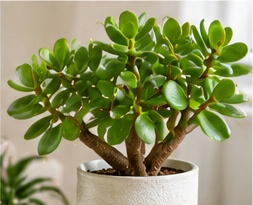
Plump, glossy and reliably long-lived, the Jade Plant is a succulent that grows like a tiny tree. Its thick, woody stems carry rounded, jade-green leaves that can develop a red edge in strong sun, and with a little patience it can become a treasured heirloom plant. It is easy to grow and easy to share.
From South African Hillsides to Houseplant Heirloom
Crassula ovata is native to South Africa and Mozambique, where it grows on dry, rocky hillsides and in scrubby bushland. It belongs to the stonecrop family, Crassulaceae. Its thick leaves and stems store water, making it well adapted to dry spells. In many cultures it is considered a symbol of good luck and prosperity, which is why it is often given as a gift.
The Secret Behind That Tree-Like Shape
With age, the main stem thickens and becomes woody, giving the plant the look of a miniature tree. Pruning encourages branching and keeps the shape tidy. In strong light the edges of the leaves can blush red. A mature plant kept in a cool, bright spot in autumn may produce clusters of tiny pink or white star-shaped flowers.
A World of Beautiful Varieties
Beyond the classic green plant there are fun variations. Hobbit and Gollum have tubular, finger-like leaves, Hummel’s Sunset has golden-yellow edges, and Variegated Jade has cream-and-pink-streaked leaves. Silver Dollar Jade is a related species with broad, silvery leaves.
Bringing the Hillside Indoors
Jade Plants love bright light, including a few hours of direct sun. Water thoroughly when the soil has dried out and then let it dry again, and water less in winter. Use a gritty, free-draining mix in a heavy pot with drainage holes, because the top-heavy plant can tip over. It is mildly toxic to cats and dogs if chewed.
Charming, hardy and endlessly easy to propagate, the Jade Plant is a plant to grow on and give away. Keep it bright and let it dry out between drinks, and it may be with you for a lifetime.
Care Guide
Everything you need to know to keep your Jade Plant happy and healthy.
A south or west window suits it. In low light it stretches and loses leaves.
Soak thoroughly and drain well. Wrinkled leaves mean thirst, while mushy or dropping leaves mean too much water.
Use cactus mix or add grit to ordinary potting soil.
Jade does well in dry household air.
Cooler nights in autumn help it flower.
Use a diluted cactus fertilizer.
Through the year
Spring
Repot, prune and take cuttings. Increase watering a little.
Summer
Water every two weeks or so. Strong light is fine.
Autumn
Water less. Cool nights help flower buds form.
Winter
Water about once a month, and keep in a cool, bright spot.
Repotting
- Repot every
- 2–3 years
- Best time
- Spring
- Pot size step-up
- Go up 1–2 inches (2.5–5 cm) in pot diameter
- Soil mix
- Cactus or succulent mix with extra grit
- Signs it needs repotting
- Roots coming from the drainage holes, or a top-heavy plant that tips its pot.
Choose a heavy ceramic or terracotta pot to balance the top-heavy plant. Jade is happy to be pot-bound.
Propagation
- Methods
- Stem cutting, Leaf cutting
- Difficulty
- Easy
- Best season
- Spring to summer
- Time to root
- 2–6 weeks
Let a stem cutting or a healthy leaf dry for a day or two so the cut end callouses. Place the cutting upright or the leaf flat on dry, gritty mix, and water lightly only after roots or tiny plantlets appear. Both root easily within a few weeks.
Common Problems
Root rot
Symptoms: Soft, mushy base or stems, a sour smell from the soil, and leaves that yellow and collapse
Likely cause: Soil that stays wet, often from overwatering or a pot with no drainage
Unpot the plant and cut away any brown, mushy roots with clean scissors. Repot in fresh, dry, free-draining mix in a pot with drainage holes and wait a week before watering. If most of the plant is soft, take healthy cuttings or offsets and start again. Mushy, dropping leaves are the clue.
Wrinkled, soft leaves
Symptoms: Leaves look shriveled and thin
Likely cause: Underwatering
Water deeply. The leaves should plump up within a few days.
Leaves dropping
Symptoms: Leaves fall from the plant
Likely cause: Overwatering, a cold snap or a sudden change in light
Check the soil and keep conditions steady.
Mealybugs and spider mites
Symptoms: White cottony clusters in the leaf joints, or fine webbing and pale speckling on the leaves
Likely cause: Sap-sucking insects, more common on stressed plants and in dry, warm rooms
Isolate the plant. Wipe visible bugs away with a cotton swab dipped in rubbing alcohol, then spray or wipe all leaf surfaces with insecticidal soap. Repeat weekly for at least a month, and rinse the plant in the shower first if the infestation is heavy.
Companion Plants
Plants that grow happily alongside this one.
Download Care Guide
A printable one-page Jade Plant care sheet: light, water, feeding and top tips.