

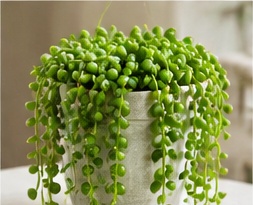
String of Pearls
Curio rowleyanus
Trailing strands of round, bead-like leaves, a delicate-looking succulent for a sunny hanging pot.
About String of Pearls
Whimsical, delicate and instantly recognizable, the String of Pearls is a trailing succulent whose stems are covered in tiny, pea-shaped leaves. It tumbles from a hanging pot or shelf in long, green strands that look like beads on a string, and a happy plant can grow into a cascading curtain. It is a lovely plant, but it has its quirks.
From South African Rock Crevices to Hanging Baskets
The String of Pearls is native to the dry regions of southwestern Africa, where it grows as a creeping groundcover in the shade of rocks and shrubs. It belongs to the daisy family, Asteraceae, and was long known as Senecio rowleyanus, before being moved to the genus Curio. Both names are still widely used.
The Secret Behind Those Tiny Pearls
Each pea-like bead is a leaf that has evolved into a nearly round shape to store water while exposing as little surface as possible to the sun. Each bead has a tiny translucent strip, called a window, that lets light reach the inside of the leaf. In the wild the strands creep along the ground and root where they touch soil, and mature plants may produce small white flowers with a cinnamon-like scent.
A World of Beautiful Varieties
The plain green plant is the classic, and a variegated form has creamy, pink-tinged leaves. Related plants include String of Hearts, String of Bananas and String of Dolphins, all with similarly quirky trailing shapes. Their care is closely related.
Bringing the Desert Indoors
String of Pearls loves bright, indirect light and a few hours of gentle sun. Water only when the soil has dried out, usually every two weeks, using a gritty, fast-draining mix in a shallow pot with drainage holes. Overwatering is the main cause of failure. The plant is toxic to cats, dogs and people if eaten, so hang it out of reach.
Delicate, whimsical and eye-catching, the String of Pearls is a great plant for a sunny window. Give it bright light, a gritty mix and a light touch with the watering can, and it will tumble down in beautiful strands.
Care Guide
Everything you need to know to keep your String of Pearls happy and healthy.
Strands stretch and the beads shrink in low light. Strong midday sun can scorch the pearls.
Soak, drain and let the soil dry out before watering again. Wrinkled pearls mean thirst, while mushy ones mean too much water.
Use cactus mix with extra perlite or sand, in a shallow pot with drainage holes.
It prefers dry air.
Keep above 45°F (7°C) and away from cold drafts.
Use a diluted cactus fertilizer.
Through the year
Spring
Repot and take cuttings. Water more often as growth starts.
Summer
Water every two weeks, in bright light but not hot midday sun.
Autumn
Water less as light fades.
Winter
Water about once a month and keep cool and bright.
Repotting
- Repot every
- 2–3 years
- Best time
- Spring
- Pot size step-up
- Same size or one size up; use a shallow pot
- Soil mix
- Cactus or succulent mix with extra grit
- Signs it needs repotting
- Roots at the surface or coming through the drainage holes, or soil that has become compacted.
Use a shallow pot, as the roots are fine and shallow. Be gentle, as the strands break easily.
Propagation
- Methods
- Stem cutting
- Difficulty
- Easy
- Best season
- Spring to summer
- Time to root
- 2–4 weeks
Cut several 4-inch (10 cm) strands and lay them on top of a shallow pot of gritty, barely damp mix, pressing the stems lightly into the soil so that nodes touch it. Keep bright and lightly damp, and the strands will root in a few weeks. A fuller pot looks best, so plant several cuttings together.
Common Problems
Root rot
Symptoms: Soft, mushy base or stems, a sour smell from the soil, and leaves that yellow and collapse
Likely cause: Soil that stays wet, often from overwatering or a pot with no drainage
Unpot the plant and cut away any brown, mushy roots with clean scissors. Repot in fresh, dry, free-draining mix in a pot with drainage holes and wait a week before watering. If most of the plant is soft, take healthy cuttings or offsets and start again. Mushy, collapsing strands are the usual sign.
Flat or wrinkled pearls
Symptoms: The beads look shriveled
Likely cause: Underwatering
Water thoroughly and let it drain. The beads should plump within days.
Bare strands
Symptoms: Beads drop, leaving long bare stems
Likely cause: Low light, overwatering or stress
Move to brighter light and keep watering steady. Trim bare strands and re-root cuttings.
Mealybugs and spider mites
Symptoms: White cottony clusters in the leaf joints, or fine webbing and pale speckling on the leaves
Likely cause: Sap-sucking insects, more common on stressed plants and in dry, warm rooms
Isolate the plant. Wipe visible bugs away with a cotton swab dipped in rubbing alcohol, then spray or wipe all leaf surfaces with insecticidal soap. Repeat weekly for at least a month, and rinse the plant in the shower first if the infestation is heavy.
Companion Plants
Plants that grow happily alongside this one.



Download Care Guide
A printable one-page String of Pearls care sheet: light, water, feeding and top tips.
You Might Also Like
View More Plants →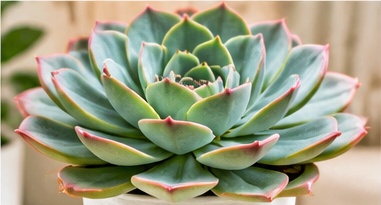
Echeveria
Echeveria
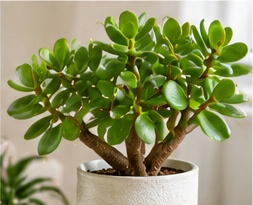
Jade Plant
Crassula ovata