

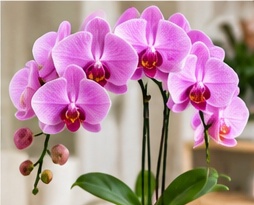
Moth Orchid
Phalaenopsis
Long-lasting, graceful blooms on arching stems, the easiest orchid to grow indoors.
About Moth Orchid
Elegant, long-lasting and surprisingly approachable, the Moth Orchid is the orchid most people take home from the store. Its broad, flat flowers open along an arching stem and can last two to three months, rising above a rosette of thick, glossy leaves. It is a wonderful plant for a bright windowsill, and with a little care it will bloom again.
From Tropical Treetops to Windowsill Star
Moth Orchids are native to the tropical forests of Southeast Asia, New Guinea and northern Australia, where they grow on trees as epiphytes. Instead of rooting in soil, their thick, silvery roots cling to bark and absorb moisture from the air and rain. They belong to the orchid family, Orchidaceae. The botanist Carl Blume named the genus in 1825, from the Greek for ‘moth-like’.
The Secret Behind Those Silvery Roots
Moth Orchid roots are green when wet and silvery when dry, and they photosynthesize as well as take in water. That is why many orchids are sold in clear pots, which let light reach the roots and make it easy to tell when to water. They are grown in chunky bark rather than soil, which allows air to circulate.
A World of Beautiful Varieties
Moth Orchids come in an impressive range of colors, from pure white and soft pink to deep purple, yellow and striped or speckled types. Mini Moth Orchids are compact, with smaller flowers on shorter spikes. Despite the variety, their care is almost the same.
Bringing the Treetops Indoors
Moth Orchids like bright, indirect light, an east window being ideal. Water about once a week by soaking the bark and then letting it drain, and never leave it sitting in water. Warm temperatures and moderate humidity suit them. A cooler spell of a few degrees at night in autumn can encourage a new flower spike. They are non-toxic to cats and dogs.
Graceful, long-lasting and rewarding, the Moth Orchid is the perfect way to start with orchids. Keep it bright and not too wet, and it will return the favor with months of beautiful blooms.
Care Guide
Everything you need to know to keep your Moth Orchid happy and healthy.
An east window is perfect. Dark green leaves mean too little light, while yellow or scorched leaves mean too much.
Soak the pot in lukewarm water for about 10 minutes, drain fully and do not let water collect in the crown. Wait until the roots look silvery before watering again.
A chunky bark mix lets air reach the roots. Use a pot with drainage.
A pebble tray or nearby humidifier helps in dry rooms.
A drop of about 10°F (5°C) at night in autumn can trigger flowering.
Use an orchid fertilizer and flush with plain water monthly.
Through the year
Spring
Repot after flowering and begin feeding.
Summer
Keep warm and humid, and out of direct midday sun.
Autumn
Cooler nights and slightly less water help trigger a new flower spike.
Winter
Flowering season for many plants. Keep bright and away from drafts.
Repotting
- Repot every
- 1–2 years
- Best time
- After flowering
- Pot size step-up
- Same size or one size up, in fresh orchid bark
- Soil mix
- Orchid bark mix (not regular potting soil)
- Signs it needs repotting
- Roots spilling far over the sides, bark that has broken down into mush, or a plant that looks wobbly in the pot.
Use a clear pot with slits or holes. Repot after flowering, and trim any dead, mushy roots.
Propagation
- Methods
- Offsets / pups
- Difficulty
- Tricky
- Best season
- After flowering
- Time to root
- Keikis take 3–6 months to root
Moth Orchids sometimes grow a baby plant, called a keiki, on the flower stem or at the base. When the keiki has several roots at least 2 inches (5 cm) long, cut it off with a clean knife and pot it in fine orchid bark. Keep it humid and warm.
Common Problems
Wrinkled, limp leaves
Symptoms: Leaves look leathery and creased
Likely cause: Underwatering, or roots rotted by overwatering
Check the roots. Plump silver-green roots mean thirst; brown mushy roots mean rot. Trim rotted roots and repot in fresh bark.
Buds dropping before opening
Symptoms: Buds yellow and fall off
Likely cause: A sudden draft, move or temperature change
Keep the plant in a steady spot away from drafts and heaters.
No new blooms
Symptoms: Healthy leaves but no flower spike
Likely cause: Not enough light, or no cooler night spell
Move to brighter light and give a few weeks of cooler nights in autumn.
Mealybugs and spider mites
Symptoms: White cottony clusters in the leaf joints, or fine webbing and pale speckling on the leaves
Likely cause: Sap-sucking insects, more common on stressed plants and in dry, warm rooms
Isolate the plant. Wipe visible bugs away with a cotton swab dipped in rubbing alcohol, then spray or wipe all leaf surfaces with insecticidal soap. Repeat weekly for at least a month, and rinse the plant in the shower first if the infestation is heavy.
Companion Plants
Plants that grow happily alongside this one.



Download Care Guide
A printable one-page Moth Orchid care sheet: light, water, feeding and top tips.
You Might Also Like
View More Plants →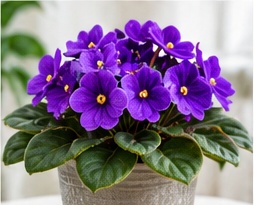
African Violet
Streptocarpus ionanthus

Boston Fern
Nephrolepis exaltata 'Bostoniensis'
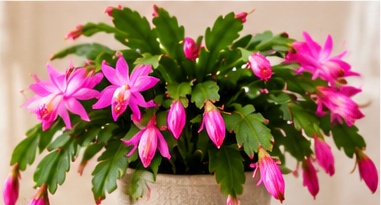
Christmas Cactus
Schlumbergera × buckleyi