

Calathea
Goeppertia
A group of tropical plants with boldly patterned leaves that purple underneath and move with the light.
About Calathea
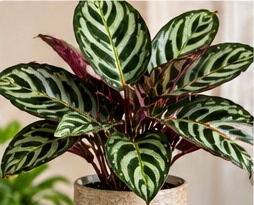
Few houseplants can match the Calathea for sheer pattern. Their broad, oval leaves are brushed, striped or feathered in shades of green, cream and silver, with undersides often flushed with deep purple. They are also in constant slow motion: the leaves rise and fall through the day. They are beautiful, a little demanding and absolutely worth the effort.
From Rainforest Floor to Plant Shelf
Calatheas are native to the tropical forests of Central and South America, where they grow on the shady forest floor in warm, humid air. They belong to the prayer plant family, Marantaceae. In 2012 botanists moved most of the species sold as Calathea into the genus Goeppertia, so you will see both names on labels. Many familiar plants, such as the Peacock Plant and Rattlesnake Plant, are part of this group.
The Secret Behind Those Moving Leaves
Calathea leaves are attached by a flexible joint at the base of the leaf stalk, which lets them respond to light. They tend to lie flat in the day and fold upward in the evening, a movement known as nyctinasty. The dramatic patterns are the result of differences in the amount of green pigment across the leaf, creating stripes, spots and feathering that vary between species.
A World of Beautiful Varieties
The picture shows a boldly striped type, one of the many Calatheas in cultivation. Others include the Rattlesnake Plant with long, wavy leaves, the round-leaved Orbifolia with silver stripes, the Pinstripe with fine pink lines, and the Medallion with its dark green and burgundy leaves. Each has its own character, but their care is closely related.
Bringing the Rainforest Indoors
Calatheas prefer medium to bright, indirect light and no direct sun, which fades and scorches the pattern. Keep the soil lightly and evenly moist and avoid letting it dry out. They want warmth and high humidity, and they are sensitive to the minerals and chemicals in tap water, so filtered, rain or distilled water is best. They are non-toxic to cats and dogs.
Bold, beautiful and a little dramatic, Calatheas reward careful care with spectacular foliage. Give them humidity, gentle light and soft water, and they will put on a show every day.
Care Guide
Everything you need to know to keep your Calathea happy and healthy.
Direct sun scorches and fades the patterns, and too little light dulls them. An east window or a spot a few feet back from a bright window suits most types.
Water when the top inch of soil is just dry, using lukewarm water. Do not let it dry out completely or sit in water.
A mix of potting soil, perlite and orchid bark gives roots oxygen while holding moisture.
Use a humidifier, group plants together or place it in a bright bathroom. Misting alone does little.
Keep it away from cold drafts, air-conditioning and heaters.
Calatheas are sensitive to fertilizer salts, so dilute well and skip it in winter.
Through the year
Spring
Repot and divide as growth restarts. Water a little more often.
Summer
Peak growth: keep soil evenly moist and humidity high, out of direct sun.
Autumn
Reduce watering slightly as light fades.
Winter
Water less, keep warm and avoid drafts. Growth slows or pauses.
Repotting
- Repot every
- 1–2 years
- Best time
- Spring
- Pot size step-up
- Go up 1–2 inches (2.5–5 cm) in pot diameter
- Soil mix
- Light, airy mix: potting soil with perlite and a little orchid bark
- Signs it needs repotting
- Roots coming out of the drainage holes, soil that dries within a couple of days, or crowded, slowing growth.
Calatheas like to be slightly snug. Use a pot only one size larger, and use fresh, loose mix.
Propagation
- Methods
- Division
- Difficulty
- Moderate
- Best season
- Spring
- Time to root
- Divisions re-establish in 2–4 weeks
Division is the only reliable method. When repotting in spring, tease the clump into sections, each with several leaves and a healthy set of roots. Pot each in fresh, airy mix, water lightly and keep the divisions warm and humid until new growth appears.
Common Problems
Brown, crispy leaf edges
Symptoms: Edges and tips brown and dry
Likely cause: Dry air, tap-water minerals or irregular watering
Use filtered or rainwater, raise humidity and keep the soil evenly moist. Trim the damaged edges.
Curling leaves
Symptoms: Leaves roll inward and stay curled in daytime
Likely cause: Thirst, low humidity or cold drafts
Check the soil, increase humidity and move away from drafts.
Spider mites
Symptoms: Fine webbing and speckled, dull leaves
Likely cause: Dry air favors mites
Rinse the leaves, wipe with insecticidal soap and repeat weekly. Raise humidity to prevent a return.
Yellowing leaves
Symptoms: Leaves turn yellow and soft, often the lower ones first; the soil stays wet
Likely cause: Overwatering or a pot without drainage
Let the top 2 inches (5 cm) of soil dry out between waterings and empty any saucer after watering. If the soil smells sour, slide the plant out and check the roots: healthy roots are firm and pale, rotten ones are brown and mushy. Trim the bad ones and repot in fresh, free-draining mix.
Companion Plants
Plants that grow happily alongside this one.
Download Care Guide
A printable one-page Calathea care sheet: light, water, feeding and top tips.
You Might Also Like
View More Plants →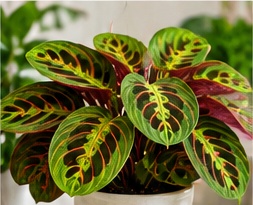
Prayer Plant
Maranta leuconeura