

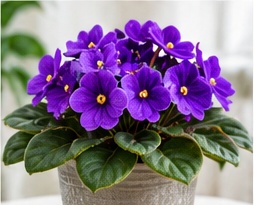
African Violet
Streptocarpus ionanthus
Velvety leaves and clusters of jewel-colored flowers that bloom almost all year.
About African Violet
Compact, colorful and charmingly old-fashioned, the African Violet is a houseplant that blooms nearly all year when it is happy. Its velvety, rounded leaves form a neat rosette, and above them sit clusters of flowers in shades of purple, pink, blue and white. It is a plant that suits a bright windowsill and rewards a little routine.
From East African Mountains to Windowsill Classic
African Violets are native to the cloud forests of the Usambara and Uluguru mountains in northeastern Tanzania and southeastern Kenya, where they grow on shady, mossy rocks and cliffs. They were found in 1892 by a German colonial official, Baron Walter von Saint Paul-Illaire, which is why they were long called Saintpaulia. Botanists have since placed them in the genus Streptocarpus, though many people still use the old name.
The Secret Behind That Non-Stop Blooming
Because they grow in the steady, mild climate of tropical mountains, African Violets have no real seasonal rhythm, and they can bloom throughout the year. The leaves are covered in fine, soft hairs that catch moisture, which is why they dislike having water on them. Healthy plants in good light produce flower after flower, in a long-lasting display.
A World of Beautiful Varieties
Thousands of cultivars have been bred, with single, double and ruffled flowers, bi-colored petals and variegated leaves. Miniature African Violets stay just a few inches wide, while trailing types spill over the sides of a pot. They are cared for in just the same way.
Bringing the Cloud Forest Indoors
African Violets like bright, indirect light, an east or north window being ideal. Water from below or at the soil level with lukewarm water, and avoid wetting the leaves. Use a light, airy mix and a small pot, because they bloom best when slightly snug. Warm rooms and moderate humidity suit them. They are non-toxic to cats and dogs.
Friendly, floriferous and wonderfully compact, the African Violet is a houseplant with plenty of charm. Give it bright light, lukewarm water and a snug pot, and it will repay you with flowers for months on end.
Care Guide
Everything you need to know to keep your African Violet happy and healthy.
East or north windows are ideal. Too little light means no flowers, and too much causes bleached, crispy leaves.
Water at the soil level or from below, never on the leaves, as cold water leaves spots. Let the top of the soil dry slightly between waterings.
Use a peat-based mix with perlite, in a small pot with drainage holes.
Place the pot on a pebble tray, but avoid misting the leaves.
Keep away from cold drafts and hot radiators.
Use a balanced fertilizer made for African Violets, at the recommended strength.
Through the year
Spring
Repot if needed and feed regularly. Take leaf cuttings.
Summer
Keep out of hot direct sun and water regularly.
Autumn
Reduce feeding as light fades, and add supplementary light if needed.
Winter
Keep warm and bright, and water with lukewarm water to avoid chilling the roots.
Repotting
- Repot every
- Every year
- Best time
- Any time, ideally after flowering
- Pot size step-up
- Pot only slightly bigger, if at all
- Soil mix
- Light African violet mix, with peat and perlite
- Signs it needs repotting
- A long, bare ‘neck’ below the leaves, or crowded plant with fewer flowers.
African Violets bloom best in small pots. Repot only when the plant has a long neck, and set it deeper in fresh mix.
Propagation
- Methods
- Leaf cutting
- Difficulty
- Easy
- Best season
- Spring to summer
- Time to root
- 3–6 weeks for roots, 2–3 months for plantlets
Take a healthy mature leaf with 1–2 inches (3–5 cm) of stalk. Cut the stalk at an angle and insert it in a small pot of damp, light mix. Cover loosely with a clear bag and keep it warm and bright. Within a couple of months, tiny plantlets form at the base of the leaf; separate them when they have a few leaves of their own.
Common Problems
Spotted or ringed leaves
Symptoms: Pale rings or spots on leaves
Likely cause: Cold water on the leaves
Use lukewarm water and water at the soil level. Spots do not fade.
No flowers
Symptoms: Healthy leaves but few or no blooms
Likely cause: Not enough light, or a pot that is too large
Move to a brighter spot, feed regularly and keep the pot small.
Soft, collapsing crown
Symptoms: The center of the plant turns mushy
Likely cause: Crown rot from overwatering or water in the crown
Avoid wetting the crown and let the top of the soil dry. Rot is hard to reverse, so take a leaf cutting if the plant is lost.
Mealybugs and spider mites
Symptoms: White cottony clusters in the leaf joints, or fine webbing and pale speckling on the leaves
Likely cause: Sap-sucking insects, more common on stressed plants and in dry, warm rooms
Isolate the plant. Wipe visible bugs away with a cotton swab dipped in rubbing alcohol, then spray or wipe all leaf surfaces with insecticidal soap. Repeat weekly for at least a month, and rinse the plant in the shower first if the infestation is heavy.
Companion Plants
Plants that grow happily alongside this one.

Download Care Guide
A printable one-page African Violet care sheet: light, water, feeding and top tips.
You Might Also Like
View More Plants →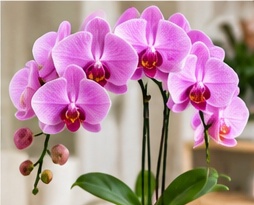
Moth Orchid
Phalaenopsis
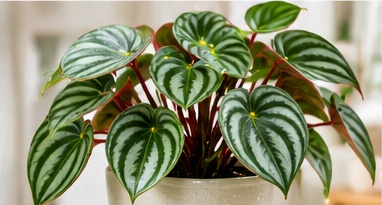
Peperomia
Peperomia