

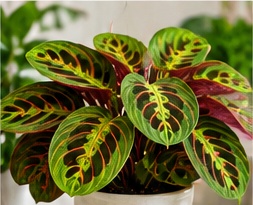
Prayer Plant
Maranta leuconeura
Velvety, patterned leaves that fold upward like praying hands each evening.
About Prayer Plant
Few houseplants are as entertaining to live with as the Prayer Plant. Its broad, oval leaves are painted with bold patterns, usually red veins on a green leaf, and every evening they lift and fold upward like hands pressed together in prayer. In the morning, they open again, as if the plant had just woken up.
From Brazilian Rainforest to Houseplant Shelf
Maranta leuconeura is native to the tropical rainforests of Brazil, where it grows as a low, spreading plant on the shady forest floor. It belongs to the Marantaceae family, the prayer plant family, and its low, trailing growth makes it a good choice for pots and hanging baskets. It thrives in the warm, humid, filtered light of the understory.
The Secret Behind Those Folding Leaves
Each leaf is attached to a small joint called a pulvinus, which swells and shrinks with water pressure as the light changes, lifting the leaf upward at night and lowering it by day. Scientists call this nyctinasty. The colorful pattern, with its bright red veins, is the plant’s signature and varies between forms, from deep green and red to pale green with dark blotches.
A World of Beautiful Varieties
The red-veined plant in the picture is the most familiar form. Others include the Green Prayer Plant, which has dark blotches that look like rabbit tracks, the Black Prayer Plant with darker, velvety leaves, and the Lemon Lime Prayer Plant, with bright, light-green leaves. They all share similar care.
Bringing the Rainforest Indoors
Prayer Plants like medium to bright, indirect light, steady warmth and high humidity. Keep the soil lightly and evenly moist, but never soggy, and use filtered or rainwater if your tap water is hard. Sudden cold, dry air and direct sun are their main enemies. They are non-toxic to cats and dogs.
Lively, colorful and a little theatrical, the Prayer Plant is a joy to watch. Give it humidity, gentle light and even moisture, and it will fill a shelf or basket with striking leaves that move with the day.
Care Guide
Everything you need to know to keep your Prayer Plant happy and healthy.
Direct sun scorches and fades the patterns, while very low light dulls them. A spot near a bright window but out of direct sun is ideal.
Water when the top inch of soil is just dry, using lukewarm, filtered water if your tap water is hard. Never let it sit in water.
Use potting soil mixed with perlite, in a shallow, wide pot with drainage holes.
Use a humidifier, a pebble tray or group plants together.
Keep it above 60°F (16°C) and away from drafts.
Too much fertilizer browns the leaf edges, so dilute it.
Through the year
Spring
Repot, divide and take cuttings. Growth speeds up.
Summer
Peak growth: keep evenly moist and humid, out of direct sun.
Autumn
Water a little less and stop feeding as light fades.
Winter
Water less, keep warm and avoid cold windows. The plant may drop some leaves.
Repotting
- Repot every
- 1–2 years
- Best time
- Spring
- Pot size step-up
- Go up 1–2 inches (2.5–5 cm) in pot diameter
- Soil mix
- Light, peaty mix with perlite
- Signs it needs repotting
- Roots from the drainage holes, growth that has stalled, or a pot packed with stems.
Prayer Plants spread outward rather than upward, so choose a wide, shallow pot.
Propagation
- Methods
- Stem cutting, Division
- Difficulty
- Easy
- Best season
- Spring to summer
- Time to root
- 2–4 weeks
Take a 4-inch (10 cm) stem cutting with at least one leaf just below a node, place it in water or moist, peaty mix and keep it warm and humid, ideally under a clear dome. Roots appear in two to four weeks. Plants can also be divided at repotting.
Common Problems
Brown, crispy leaf edges
Symptoms: Edges and tips brown and crisp
Likely cause: Dry air, tap water minerals or irregular watering
Use filtered water, increase humidity and keep watering steady.
Leaves not folding
Symptoms: Leaves stay open or flat at night
Likely cause: Too little light, or the plant is stressed
Check light levels and keep conditions steady. Movement returns when the plant recovers.
Spider mites
Symptoms: Fine webbing and speckled leaves
Likely cause: Dry air favors mites
Rinse the leaves, wipe with insecticidal soap and repeat weekly.
Yellowing leaves
Symptoms: Leaves turn yellow and soft, often the lower ones first; the soil stays wet
Likely cause: Overwatering or a pot without drainage
Let the top 2 inches (5 cm) of soil dry out between waterings and empty any saucer after watering. If the soil smells sour, slide the plant out and check the roots: healthy roots are firm and pale, rotten ones are brown and mushy. Trim the bad ones and repot in fresh, free-draining mix.
Companion Plants
Plants that grow happily alongside this one.
Download Care Guide
A printable one-page Prayer Plant care sheet: light, water, feeding and top tips.
You Might Also Like
View More Plants →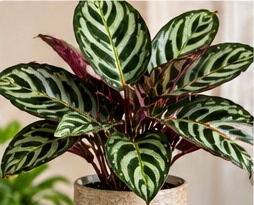
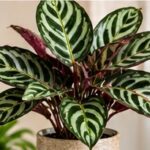
Calathea
Goeppertia